
Orion Rising and Airglow
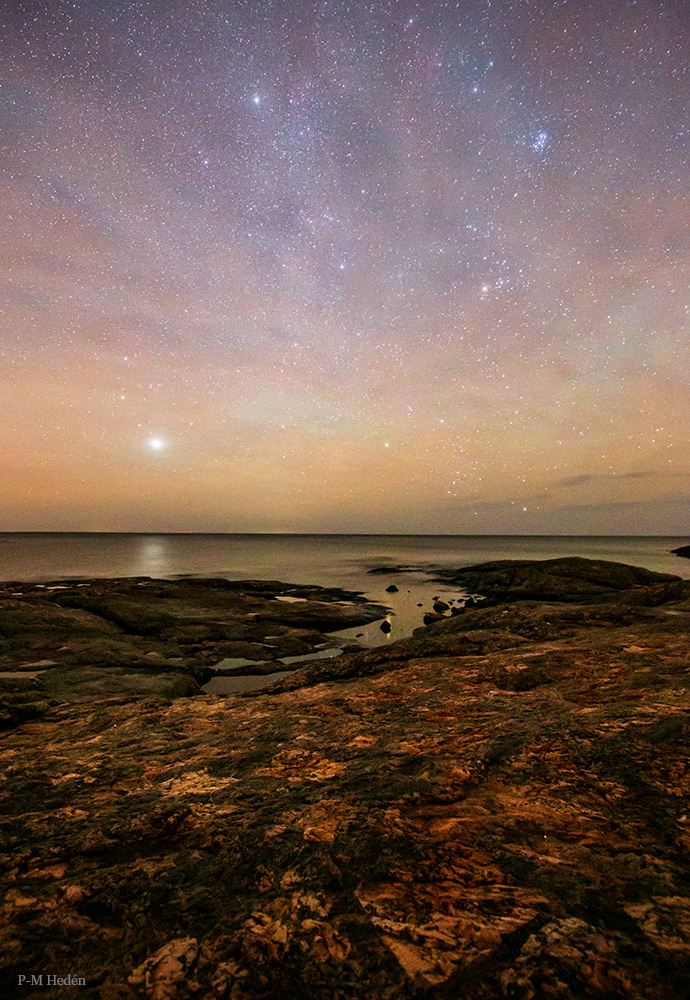
Description
Bright planet Jupiter with the stars Castor and Pollux above (left), constellation Auriga and Taurus (middle) with the open cluster M45 Pleiades (right), and constellation Orion rising from the ocean. Additionally, there is also heavy airglow visible to the naked eye. Airglow is a faint emission of light by a planetary atmosphere. In the case of Earth’s atmosphere, this optical phenomenon causes the night sky never to be completely dark, even after the effects of starlight and diffused sunlight from the far side are removed. This phenomenon originates with self-illuminated gases and has no relationship with Earth’s magnetism or sunspot activity, causing aurorae.
On planet Earth
Feldspar, sometimes spelled felspar, is a group of rock-forming aluminum tectosilicate minerals, also containing other cations such as sodium, calcium, potassium, or barium. The most common members of the feldspar group are the plagioclase (sodium-calcium) feldspars and the alkali (potassium-sodium) feldspars. Feldspars make up about 60% of the Earth’s crust and 41% of the Earth’s continental crust by weight.
Feldspars crystallize from magma as both intrusive and extrusive igneous rocks and are also present in many types of metamorphic rock. Rock formed almost entirely of calcic plagioclase feldspar is known as anorthosite. Feldspars are also found in many kinds of sedimentary rocks.
comments (3)